How history shapes us: commemorating the Korean War anniversary
How history shapes us: commemorating the Korean War anniversary
The following article was written by Kirsty Anderson, who was invited by Veterans' Affairs to attend and write her reflections of the commemoration.
_______________________________________________________________________________________________________________
Koreans sing Yeon-ga, the Korean version of Pōkarekare Ana, and enjoy our meat and dairy products. New Zealanders enjoy K-pop, K-beauty, and Korean foods (especially fried chicken).
New Zealand has a strong relationship with the Republic of Korea and well-established political, economic, and cultural ties. I recently learnt how this relationship stems from New Zealand’s involvement in the Korean War in the 1950s.
I attended the commemoration event in the Hall of Memories at Pukeahu National War Memorial Park to mark the 76th anniversary of New Zealand’s involvement with the Korean War. The hall forces feelings of reverence; it has twelve small chapels with memorial plaques for New Zealand military services and the rolls of Honour listing over 30,000 names of those who have died in service.
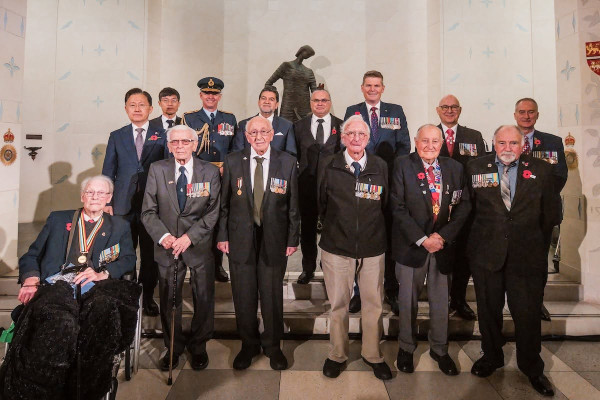
Veterans at the commemoration of the 76 th anniversary of New Zealand’s involvement with the Korean War. Photo credit to Ministry for Culture and Heritage, Elias Rodriguez/Mark Tantrum Photography
Most of our Korean veterans are in their 90s, or even older and some are not able to travel to commemoration services. When they recall their military experiences, they are remembering events which occurred over 70 years ago. Despite the time that has passed, I observed the veterans still hold a strong sense of pride, duty and nationhood. They are keen to ensure their service, and that of their peers, is not forgotten.
The commemoration marked the anniversary of the beginning of the war on 25 June 1950 when communist North Korean forces crossed the 38th Parallel into South Korea. New Zealand was one of the first nations to respond to the United Nations Security Council’s call for military assistance following the invasion of South Korea in June 1950. The government offered two frigates and HMNZS Tutira and Pukaki left Auckland for Korea on 3 July 1950. Not long after, New Zealand provided an artillery battalion and ancillary units to serve on the ground in Korea.
In total, over 6,000 New Zealanders served during the Korean War from 1950 to 1957. Around 4,700 New Zealand Army personnel served in Kayforce, with about 1300 others on Royal New Zealand Navy frigates.
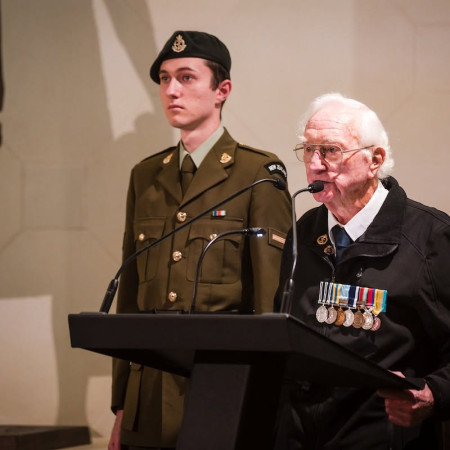
Korean War veterans, George Gardner. Photo credit to Ministry for Culture and Heritage, Elias Rodriguez/Mark Tantrum Photography
These were young men from all walks of life who committed to helping the war efforts in the fight for peace and stability. Many of them were volunteers. Many had little knowledge of life outside New Zealand. Their motivations included a sense of patriotism and duty, seeking adventure, and assisting to stop the rise of communism. At this time there was an increasing number of Māori in the armed forces. Māori made up around 14 per cent of Kayforce – at a time when they comprised only 6 per cent of New Zealand’s population.
This year’s commemoration also marked the 75th anniversary of the Battle of Kap’yong, one of the most significant engagements involving New Zealand forces during the Korean War.
In April 1951, New Zealand’s 16th Field Regiment played a critical role supporting United Nations forces during a major Chinese offensive. New Zealand gunners under immense pressure earned international respect and helped prevent a major breakthrough during a critical stage of the conflict. For their brave efforts, the regiment received a South Korean Presidential Unit Citation.
In total, there were 47 New Zealanders who lost their lives during the Korean War, including two who died serving with Australian forces.
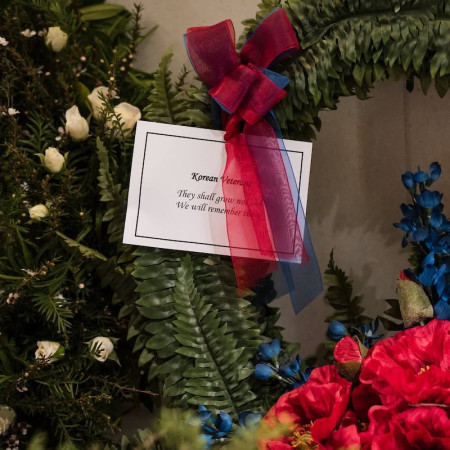
Photo credit to Ministry for Culture and Heritage, Elias Rodriguez/Mark Tantrum Photography
The Republic of Korea has changed much in the time since New Zealand was called to assist in 1950, as has New Zealand. The two countries have continued to maintain strong ties and regularly commemorate the actions of the war veterans.
When you see Korean items in our culture and society, or see New Zealand items in Korean culture and society, spare a thought of gratitude for the veterans in both countries who protected regional and global security so we can enjoy the freedoms we have today.
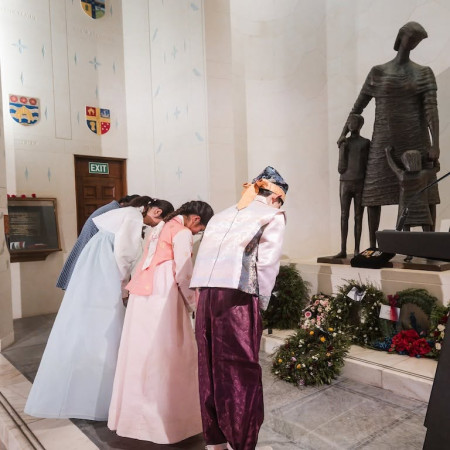
Photo credit to Ministry for Culture and Heritage, Elias Rodriguez/Mark Tantrum Photography