Remembering the Navy’s role in the Korean War
Remembering the Navy’s role in the Korean War
In 1948, George Gardner and his friend spent a weekend rowing up and down the Grey River until they knew the number of rivets that held the hull together on a frigate moored in the Port of Greymouth.
Not long after this, George enrolled in the navy at 17 years of age and was to serve on a frigate similar to the one he had seen.
He entered the navy in the Engineering Department and the higher he achieved with his qualifications, the more interesting the roles became. He enjoyed the overseas deployments, experiencing new countries and meeting people of the world.
George served 20 years in the navy, including serving in the Korean War on HMNZS Taupo.
New Zealand’s involvement in the war involved six Loch class frigates HMNZS Pukaki, Tutira, Rotoiti, Taupo, Hawea and Kaniere. Almost half the Royal New Zealand Navy at the time - approximately 1350 officers and ratings - was involved over the three years of the war.
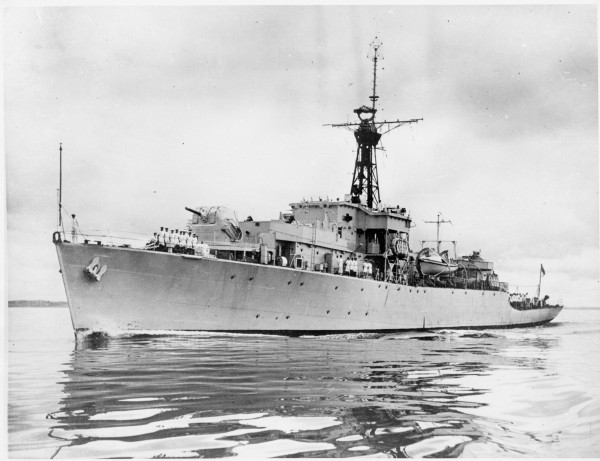
HMNZS Taupo, Torpedo Bay Navy Museum, Reference no. AAS 0033
After leaving the navy in the role of Naval Chief Marine Engineer, George developed a civilian engineering career, specialising in the expertise of the scale and corrosion in water systems and boilers, used by industrial companies and hospitals. This gave him a lot of travel around New Zealand.
In his retirement Veterans’ Support has provided assistance to George – services have included house and windows washing, lawn and garden care, hearing aids and home care.
At the recent commemoration event of the 76th anniversary of New Zealand’s involvement with the Korean War, held in Wellington on 25 June 2026, George acknowledged all who served in the Korean War. He also described the dangers and risks of being at sea in conflict.
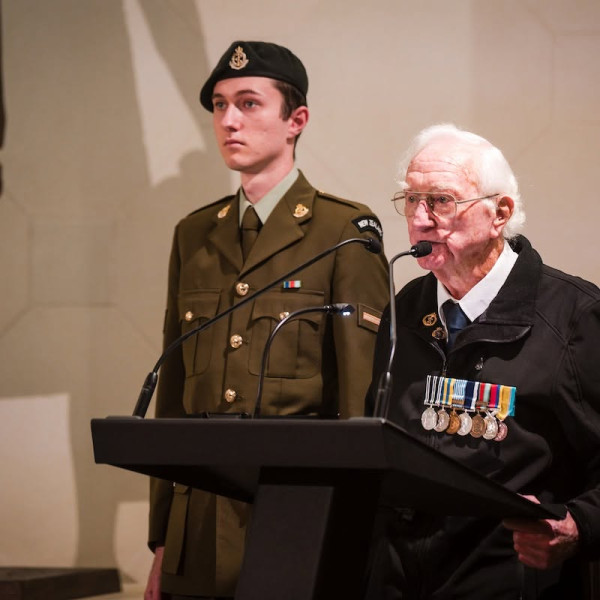
Korean War veterans, George Gardner. Photo credit to Ministry for Culture and Heritage, Elias Rodriguez/Mark Tantrum Photography
George's reading from the commemoration
I served as a stoker mechanic aboard HMNZS Taupo, a Royal New Zealand Navy Loch-class frigate deployed during the Korean War, August 1951 to October 1952. As part of New Zealand’s naval contribution to the United Nations effort, we served in Korean waters on patrol, escort, blockade and bombardment duties.
I offer this recollection in remembrance of that service, and of the men who faced the demands and dangers of war at sea.
The naval involvement in the Korean War was rather different to that of the army. As the North Koreans had no navy, our primary role was to seek and destroy their troop and supply movements along the coast of North Korea as these were enroute south towards the front line, where the two Armies were confronting each other.
Two theatres of activity were in existence where the US Navy monopolised the East Coast whilst British Commonwealth ships and others created havoc operating on the West Coast.
Occasionally interchangeability occurred where a particular class of ship was more suited for the current task, and we found our ship to be so employed on several occasions. The reason in those instances was due to the North Koreans using amphibious forces to mount dawn attacks among the islands along the Coast. These were nominally a feature of the warfare on the East Coast, where our ships would assist the US Navy with our gunnery and destroy these amphibious advances.
It was not all smooth sailing in these instances as the North Korean Army had some big guns which would engage us when we needed to be close to the shore.
As it happened, my ship – HMNZS Taupo – was so involved in one amphibious invasion, where we did receive a direct hit which holed the ship above the waterline. This happened when we were engaging with North Korean forces trying to invade the island of Yang-Do which is situated on the East Coast, 130 miles north of the 38th parallel (the border between North Korea and South Korea). No injuries were sustained and the ship continued participating in the conflict.
For the crew of HMNZS Taupo, it meant long patrols, dangerous work close to shore, and moments when the risks of war were very real.
May these memories stand as a tribute to all who served, and that their contribution not be forgotten.